Camille Saint Saëns
La danse macabre
Symphony No. 3 ‘Organ Symphony’
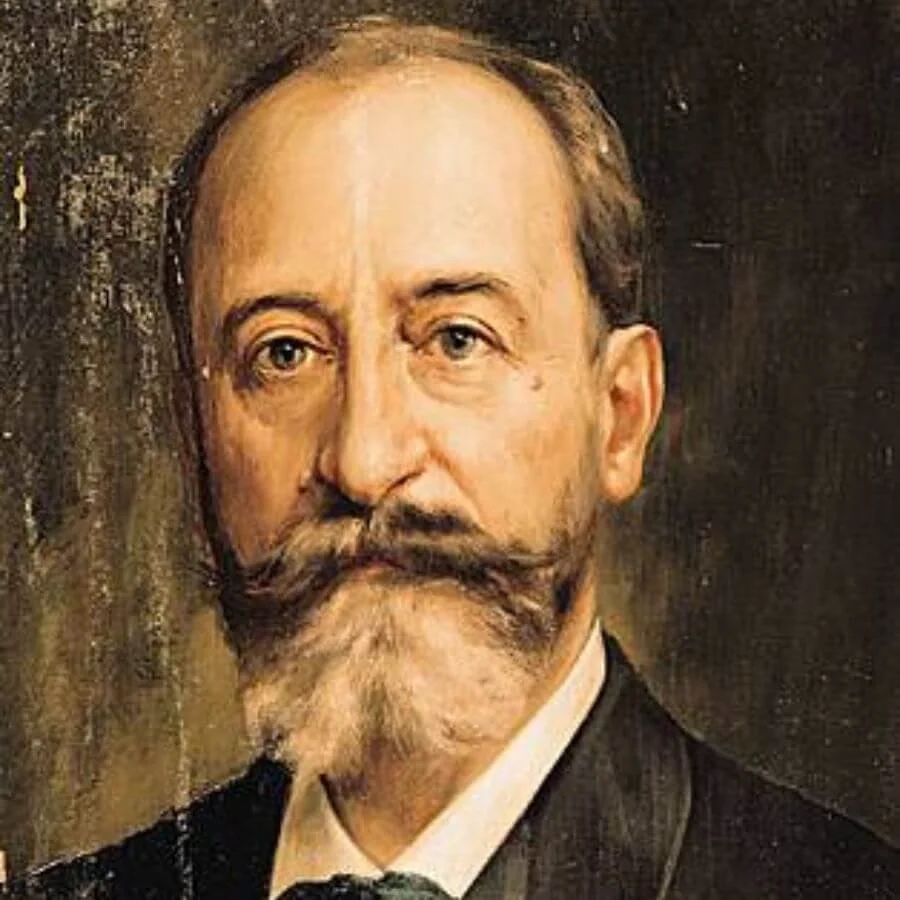
Camille Saint Saëns
1835-1921
“I produce music,” Saint-Saens once wrote, “as an apple tree produces apples.”
Camille Saint-Saëns was a prestigious composer of the Romantic era. Born in Paris, France, he lived from 1835 to 1921 - spending much of his life composing, performing, conducting, and traveling the world. He did indeed ‘produce music’ as organically and routinely as he claimed. During the course of his life, he composed over 300 finished works - operas, religious and secular choral works, ballets, orchestral works, chamber works, virtuoso pieces, and more.
Some pieces of his that you may have heard of are Carnival of the Animals, “Organ Symphony”, Violin Concerto 3, Introduction and Rondo Capriccioso, and Danse Macabre.
His career was marked by resounding success. He was one of the most famous living composers of his time, in contrast to many of his era whose fame only grew after their death!
Saint-Saens’ journey to this fame started young. He began playing the piano at the age of three, and by ten made his debut at the Salle Pleyel, with a concert that included a Mozart piano concerto - featuring a cadenza he wrote himself. The young pianist performed by memory, something considered quite remarkable at the time.
At 13, Saint-Saens enrolled in the Paris Conservatoire, studying the organ, and later adding composition, orchestration, accompaniment, and voice. He started to write even more frequently, composing his first symphony at 16, yet many of his works from this time remained incomplete. However, he began entering composition competitions, winning multiple prizes and improving his skills.
The up-and-coming composer began to earn the notice of some of the most famous composers of the day, quickly gaining the friendship and support of Viardot, Gounod, Rossini, and Berlioz. Liszt, too, was impressed by Saint-Saens, at one point (after hearing him improvise) calling him “the greatest organist in the world.”
As he gained prominence, Saint-Saens reflected this support back to his fellow composers, often active in promoting them. For example, he was one of the first to recognize Wagner’s music (though he later turned around and wrote articles advocating to have it banned!)
Saint-Saens also supported Schumann, (whose music was controversial at the time), as well as sponsoring concerts of Lizst’s music, which he was greatly inspired by. Saint-Saens’s tastes also included older composers, as he was similarly inspired by Handel and helped bring Bach’s and Mozart’s music to greater fame.
By the early 1860s, Saint-Saens had fully established himself as a famed composer and pianist - traveling abroad often and performing his own compositions. His home life was pleasant, his performing life was successful, and soon enough he began a teaching appointment at the Ecole Niedermeyer - an institute meant to improve the quality of music played in French churches. This was the only faculty position he ever held, and he stayed in it for four years. During this time, he taught and befriended a number of students - including Faure - many of whom rose to success. They spoke highly of his inspiring love for the arts of the time.
Later on, he co-founded the Société Nationale de Musique - a society meant to help promote French composers and the performance of their music. This legacy lives on today, as the society is still in existence!
He enjoyed writing articles relating to music during some of his middle-aged years, participating in spirited debates with his colleagues. Later on in his life, he returned to writing articles - notably speaking against the performance of German music during WW1.
Other parts of his life, however, weren’t so positive. At the ripe age of 40, Saint-Saens decided to marry a young woman of 19. However, the marriage did not work out in a number of ways. Firstly, his mother was not supportive; she was overbearing, possessive, and rude to both him and his wife. Secondly, Saint-Saens was not the ideal husband - often cold and detached. Their greatest tragedy, though, was the loss of both of their sons within two weeks of each other, which devastated him to the point where he separated from his wife, believing her responsible. His mother passed ten years after this, in 1888 - another great loss which resulted in him traveling to Algeria for his health.
Despite these challenges, Saint-Saens continued composing and touring the world. While his reputation in France started to lessen, America and England held him in high regard and he often traveled to them to give concerts and accept commissions. His output included his Third Symphony, Carnival of the Animals, Samson et Dalila, and a number of other operas, works for the theater, and film music. In fact, he was the first established composer to write for film! Unfortunately, a lot of the time he was able to spend on composition was due to the fact that he left the Societe Nationale due to committee decisions he disagreed with. He was given honorary doctorates by Cambridge and Oxford during this time, as well as made a Grand Officer of the Legion d’Honneur, awarded the Cross of Merit, and made the president of a school of arts.
Nearer the end of his life, he spent a considerable amount of time in Egypt and Algeria, but he continued to travel, perform, and conduct. During his lifetime, he traveled more than most other composers of that era. He closed his performing career with a concert in 1921, and closed his conducting career with a performance just a few weeks later. That winter, he died at the age of 86 and was given a state funeral in Paris.
Saint-Saens did much for the genre of French music, as well as building connections with and championing fellow composers during his lifetime. He lived a full, if not always happy, life - traveling, performing, conducting, composing, and writing through nearly all of it. His legacy lives on the many works of his that remain in our repertoire today.
Other Fun Facts:
He enjoyed playful cross-dressing.
He loved astronomy.
He worked on music editions during his Conservatory years.
He danced a spontaneous ballet with Tchaikovsky on one occasion. He forbade the performance of Carnival of the Animals during his lifetime, excepting The Swan.
He performed for Queen Victoria.
Much of the information in this article was sourced from the Grove Dictionary!
Written by Sylvia
Introduction & Rondo Capriccioso
Excerpt from Carnival of the Animals